How to Decorate an Empty Wall Without Making It Look Cluttered
Staring at a large, blank space in your home can feel daunting, but learning how to decorate an empty wall is about finding the right balance between style and restraint. The goal is not to fill every inch, but rather to create a clear focal point, visual balance, proper scale, and enough negative space to let the room breathe.
Whether your home leans toward Modern, Organic Modern, Transitional, Minimalist, Contemporary, Eclectic, Coastal, Traditional, or Bohemian, practical empty wall decor ideas exist for a range of interior styles. By establishing a thoughtful connection between your wall decor and the surrounding furniture, you can easily transform a blank canvas into a curated, calming environment.

The Secret to Wall Decor: Embracing Negative Space
Before selecting new art or shelves, it helps to understand the role of negative space. Negative space—the empty area around your furniture and decor—gives the eye a place to rest and helps important pieces stand out in a room.
If you are wondering how to decorate walls without clutter, the answer often involves leaving some areas intentionally bare. This prevents walls from feeling visually heavy and creates a more intentional relationship between your wall decor and furniture. You do not need to cover every blank space simply because it is empty.
When you focus on minimalist wall decor, you prioritize curation over volume. Selecting fewer, higher-quality items generally leads to a more sophisticated interior than accumulating dozens of random objects.
1. Anchor the Space with One Oversized Artwork
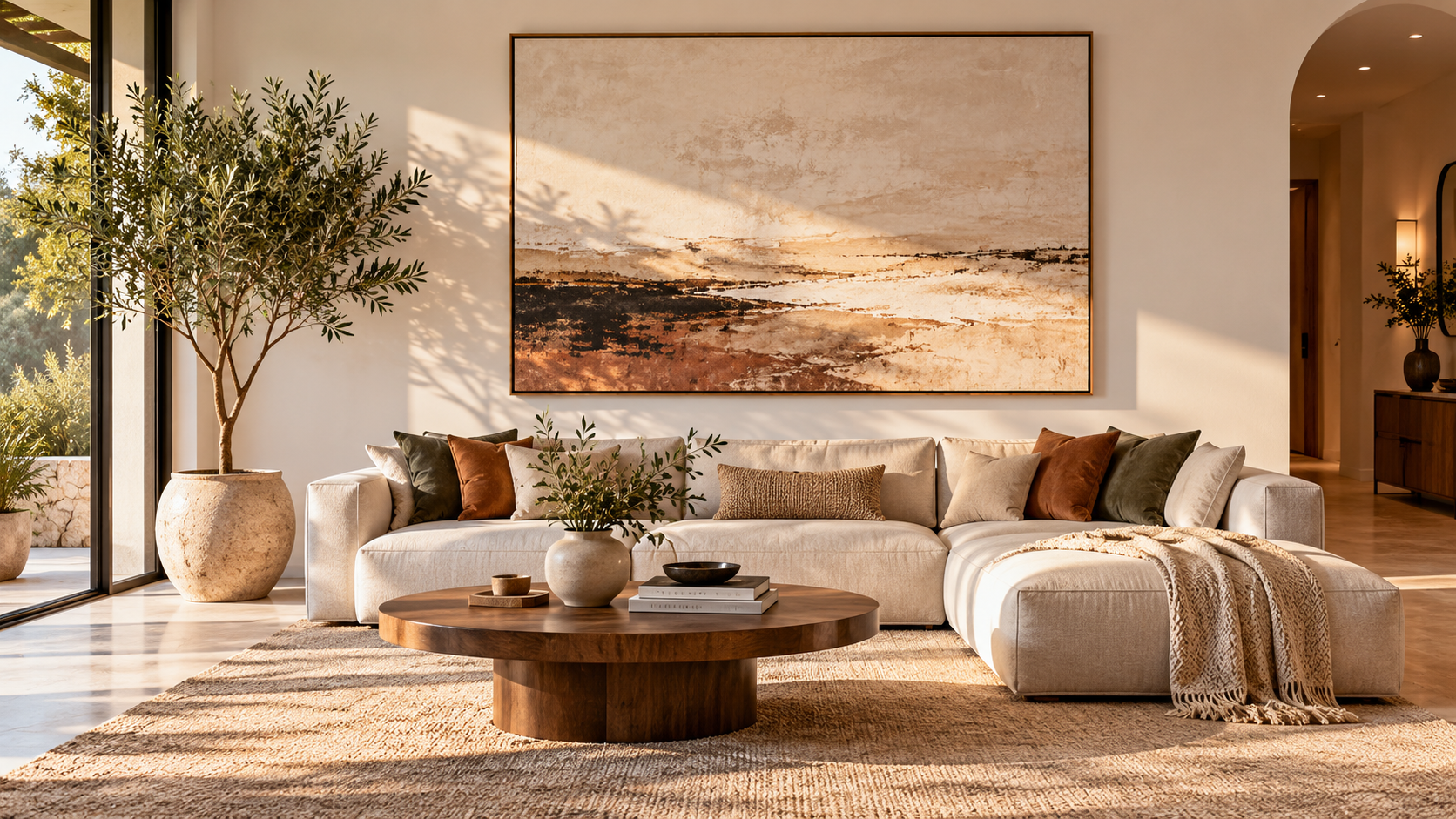
One of the best large empty wall ideas is using a single, oversized piece of art. A massive canvas often feels calmer and less visually demanding than a collection of several small pieces, providing immediate impact without adding noise.
A common starting point is hanging artwork so the center sits around 57 to 60 inches from the floor, though this can shift depending on ceiling height, furniture size, and viewing distance. If you are placing it above a sofa, a flexible guideline is to choose a canvas that spans roughly two-thirds the width of the furniture below it, ensuring the art visually relates to the seating.

2. Curate a Spaced-Out Gallery Wall
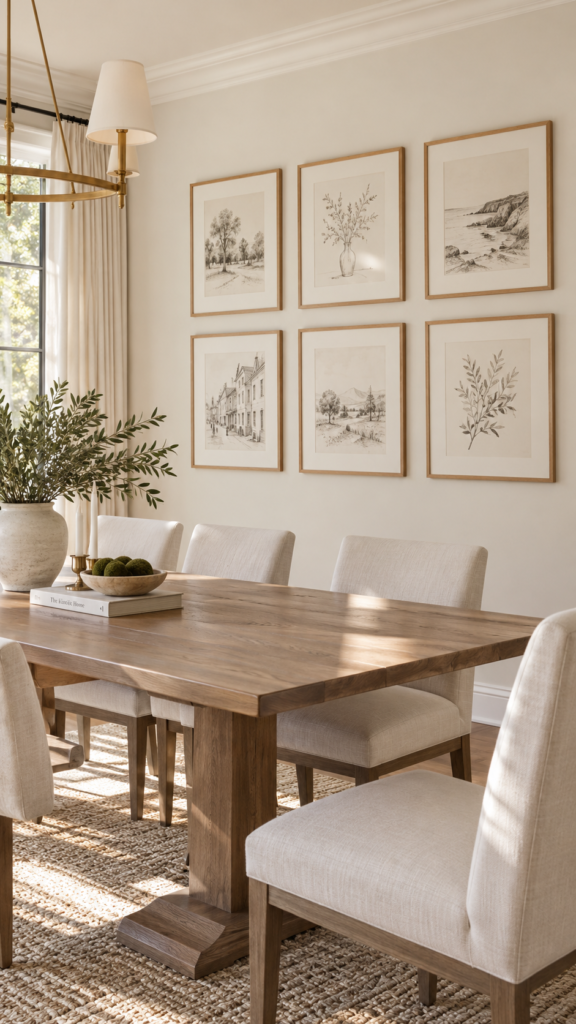
Gallery wall ideas can veer into clutter if not planned carefully, but a well-executed arrangement adds immense character. The key is consistent spacing, visual balance, and a clear relationship between the frames.
Both structured grids and relaxed salon-style arrangements work well when spacing and visual hierarchy are controlled. Leaving two to three inches between frames is a useful starting point to keep the layout feeling open. Gallery walls feel much less cluttered when the frames share a color or finish, the artwork shares a palette or theme, and the overall composition forms a clear outer shape.
3. Use Large Floor Mirrors to Reflect Light
Mirrors are a versatile solution for living room wall decor. They reflect light, create depth, and introduce scale without adding heavy visual detail to the room.
When deciding what to put on an empty wall, consider leaning a large floor mirror to open up the space. Ensure the mirror reflects something pleasing, like a window or an indoor plant, rather than clutter or an awkward corner. Safety note: Always secure large leaning mirrors to the wall with appropriate hardware, especially in homes with children or pets.

4. Install Floating Shelves with Restraint
Floating shelves blend storage with design, but they require strict curation to remain minimalist. If you are learning how to decorate a blank wall with shelving, remember that odd-numbered groupings can often feel relaxed and visually balanced, but they are not strictly required.
To keep shelves from feeling heavy, focus on varied heights and leave plenty of open space between objects. Mix items like stacked books, ceramics, greenery, and one sculptural piece, avoiding filling the shelves from edge to edge. Generally, displaying fewer larger objects looks much calmer than displaying many tiny accessories.

5. Soften the Room with Textiles and Wall Hangings
Hard architectural surfaces can sometimes feel cold. Introducing textiles is a smart way to soften a room, add texture, and absorb some visual harshness.
From framed vintage fabrics and tufted tapestries to macrame and vertically hung rugs, textiles introduce pattern without requiring multiple framed pieces. Utilizing one large textile usually creates a calmer result than hanging several small textile pieces, making it an excellent choice for a simple, relaxed aesthetic.

6. Add Dimension with Wall Sconces
Lighting serves as a highly effective decorative tool. Wall sconces add ambient light, depth, and architectural interest to a flat surface, casting shadows that bring a room to life in the evening.
While placing sconces symmetrically on either side of a bed or sofa is a classic approach, asymmetrical placement can also work beautifully in contemporary or eclectic rooms. If hardwiring is not practical in your home, plug-in sconces are an accessible alternative that provides the exact same dimensional appeal.

7. Introduce Organic Shapes with Sculptural Decor
To make your wall visually interesting without relying solely on flat canvases, incorporate 3D elements. Woven baskets, ceramic wall pieces, abstract metal wall art, and carved wood add character through distinct shapes and textures.
Sculptural wall art ideas work best when treated as one cohesive composition rather than a scattering of unrelated small objects. Repeating a material, color, shape, or finish will help connect the individual pieces, ensuring the wall feels grounded and intentional.

8. Create a Vertical Indoor Garden
Mounting a series of sleek wall planters is a lively way to fill an empty wall. However, before choosing your greenery, it is important to consider the room’s actual environmental conditions.
Evaluate the available natural light, humidity levels, watering access, and the mature size of the plants. Select greenery suited to the specific light conditions of the room, as not every trailing plant will thrive in every space. When appropriately matched to their environment, living plants bring a fresh, dynamic element to blank walls.

9. Paint an Accent Arch or Color Block
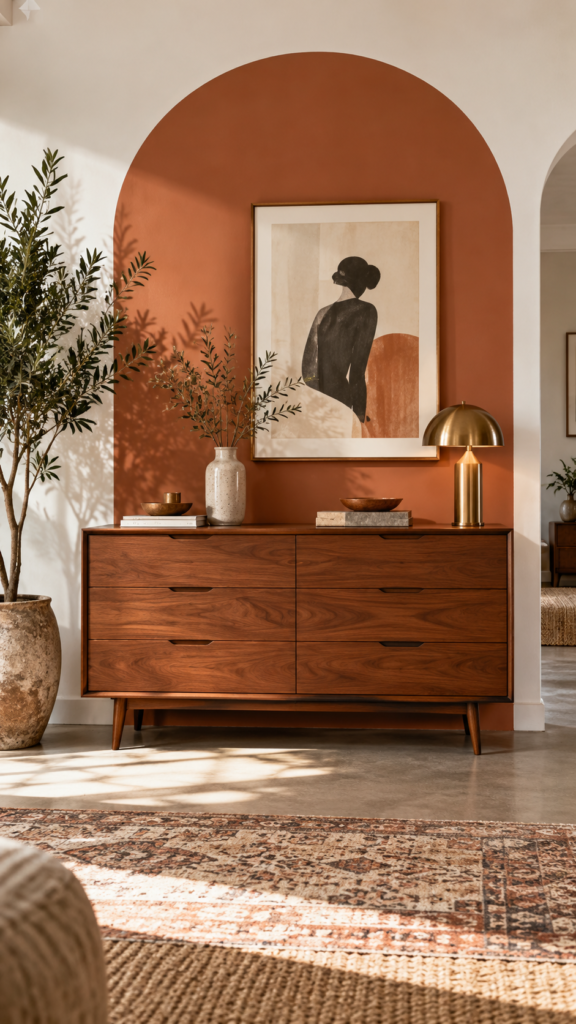
When figuring out how to fill a large blank wall on a limited budget, paint is an excellent tool. A painted arch or color block is a simple way to create architectural interest with paint without requiring additional physical objects.
These painted shapes can visually anchor a console, a reading chair, a floating shelf, a mirror, or a small desk. By framing the furniture, the color block turns an expansive empty wall into a defined, purposeful zone.
10. Incorporate a Decorative Wooden Ladder
A decorative ladder is a charming piece of decor that occupies vertical space without requiring any wall mounting. You can use the rungs to drape soft textiles, like cozy knit throw blankets in a living area or linen towels in a bathroom.
Ensure you use a stable ladder intended specifically for interior styling, avoiding unstable functional ladders as decor. Safety note: Use a stable decorative ladder and secure it when necessary, especially in homes with children or pets.

How to Choose Wall Decor Based on Wall Size
Understanding how to decorate a wall without overcrowding it largely depends on the dimensions of the space. Here is practical guidance for styling different wall types:
- Narrow Walls: Use tall, vertical artwork, slim mirrors, or vertically stacked sconces to complement the height.
- Wide Walls: Choose oversized artwork, a large mirror, a controlled gallery wall, or a trio of related pieces to span the width comfortably.
- Walls Above a Sofa: Make the wall decor visually relate to the sofa width and the overall seating arrangement to keep the room grounded.
- Hallway Walls: Keep depth shallow and avoid bulky pieces that project too far into the walkway.
- High-Ceiling Walls: Use larger-scale art, vertical compositions, or statement lighting to connect the lower furniture zone with the height of the room.
Common Empty Wall Decorating Mistakes
Even with great decor pieces, execution matters. Here are common pitfalls and how to solve them:
- Choosing art that is too small: Small art gets lost on a large wall. Solution: Size up or group smaller pieces together.
- Hanging artwork too high: This disconnects the art from the furniture. Solution: Lower it closer to eye level or to the furniture below.
- Overcrowding the wall: Too many items cause visual chaos. Solution: Edit down to a few strong statement pieces.
- Ignoring the furniture below: Floating art looks unanchored. Solution: Treat the art and furniture as a single visual unit.
- Mixing too many unrelated styles: This creates a jarring look. Solution: Stick to a cohesive theme or material palette.
- Inconsistent spacing: Random gaps in a gallery wall look messy. Solution: Measure and maintain even spacing between frames.
- Using too many tiny objects: Tiny decor often reads as clutter. Solution: Swap multiple small items for fewer, larger ones.
- Choosing wall decor with no relationship to the room’s color palette: The wall will feel disjointed. Solution: Pull one or two existing colors from the room into your wall decor.
- Filling every empty wall simply because it is empty: Over-decorating shrinks a room. Solution: Leave some walls bare to let the space breathe.
Core Principles for Styling Your Blank Walls
Evaluate Scale and Proportion
Wall decor should be evaluated in relation to furniture width, ceiling height, wall width, viewing distance, and neighboring architectural features. While aiming for your decor to span roughly two-thirds to three-quarters of the width of the furniture below is a common starting point, these ratios are flexible guidelines, not rigid rules.
Build a Connected Color Palette
Your blank wall decorating ideas do not need to match the room exactly. Instead, repeat one or two colors, finishes, or materials already present in your rugs, cushions, lighting, furniture, or curtains. This approach creates a subtle connection without making the room feel overly coordinated.
Anchor to Furniture Placement
Wall decor should usually relate to a visual anchor rather than the mathematical center of the wall. Possible anchors include a sofa, console, bed, dining table, fireplace, or a cozy reading chair. Centering art on the furniture often looks much better than centering it on the entire wall.

Frequently Asked Questions
What should I put on a large empty wall?
The best decor for a large empty wall includes oversized artwork, a large floor mirror, or a carefully curated gallery wall. Using fewer, larger items generally creates a more sophisticated and less cluttered look than hanging many small pieces.
How do I decorate a wall without making it look busy?
Focus on simple wall decor ideas and prioritize negative space. Stick to a cohesive color palette, ensure consistent spacing between items, and use larger, more impactful pieces rather than a scattering of tiny objects.
How much wall space should I leave empty?
There is no exact percentage, but leaving enough negative space around your decor gives the eye a place to rest. Allow generous borders between your artwork and the edges of the wall, ceiling, and adjacent corners.
Should wall art be centered on the wall or the furniture?
In most cases, you should center your wall art over the furniture (like a sofa, bed, or console) rather than the mathematical center of the wall. This visually anchors the art to the room’s layout.
How big should wall art be above a sofa?
A common guideline is that wall art should span about two-thirds to three-quarters of the sofa’s width. This keeps the art proportional to the seating area so it does not look awkwardly small or overwhelmingly large.
Are gallery walls still in style?
Yes, gallery walls remain a classic choice, especially when executed with intention. To keep them looking current, opt for consistent spacing, cohesive frames, and a unified color palette or theme.
Conclusion
Mastering how to decorate an empty wall is an exercise in scale, restraint, and connection to your furniture. By choosing fewer, stronger pieces and being mindful of negative space, you can curate a room that feels complete yet calm.
When decorating, add one major element at a time, step back, and evaluate the wall before adding more. Remember that a well-designed room requires balance, and sometimes leaving some wall space empty is the strongest design choice.